
Beyond Multiple Choice: Why You Need an Online Spanish Speaking Assessment
- Jackie Amidon Donaldson

- Jul 6
- 10 min read

Understanding Spanish isn't the same as speaking it confidently. Discover why grammar quizzes and language apps can't measure real conversational ability, what actually happens during your first lesson at Amidon Studios, and how a personalized learning plan helps you move from understanding Spanish to speaking naturally in real-life conversations.
Table of Contents
The Hidden Disconnect Between Understanding and Speaking
Does this sound familiar? You can follow a Spanish-language movie, understand the gist of a conversation between native speakers, and even score well on a grammar quiz.
But when it’s your turn to speak—to ask for directions, share an opinion, or just make small talk—the words don’t come. You feel stuck, and the Spanish you know feels miles away from the Spanish you can actually use.
This is one of the most common frustrations I hear from new students. They’ve spent years studying, using apps, and accumulating vocabulary, yet they can’t have a simple, natural conversation.
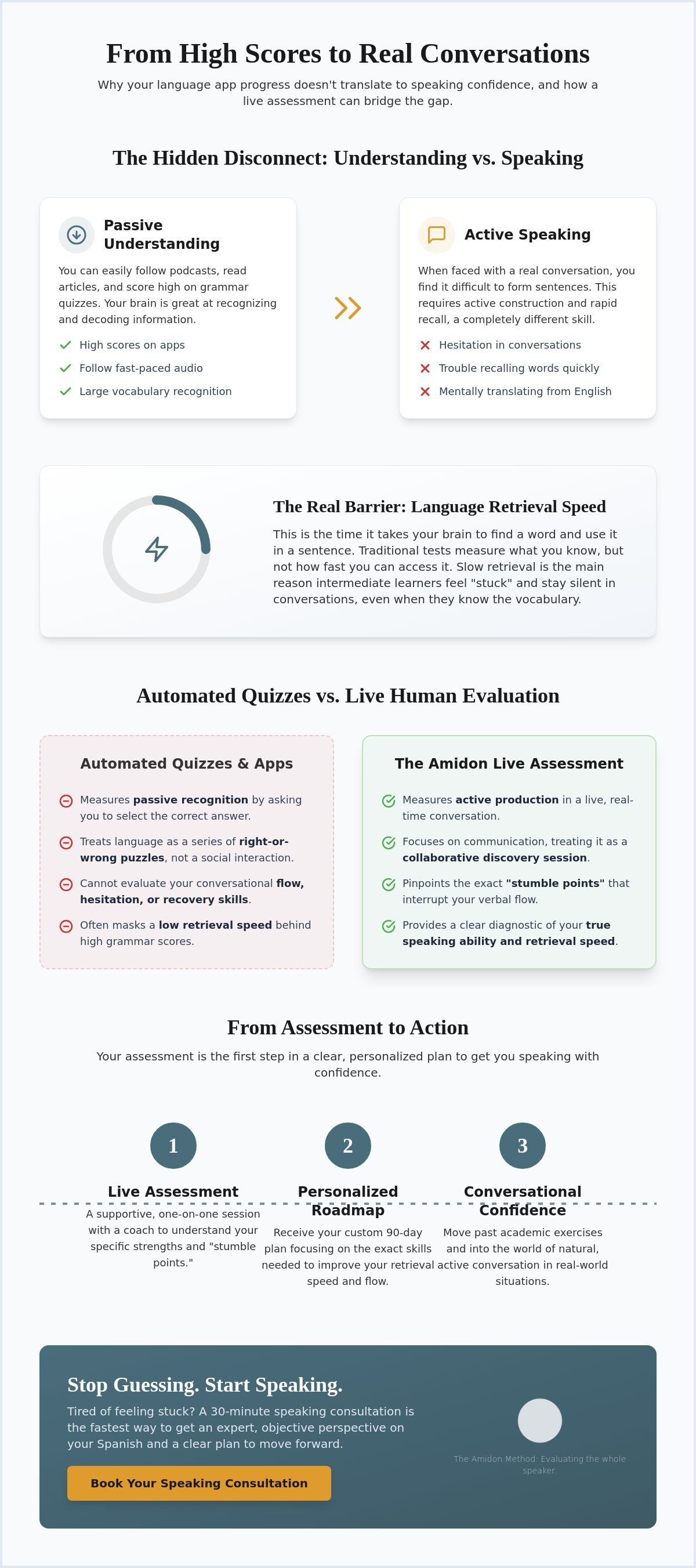
The reason is simple: most learning methods and online tests are built to measure your passive knowledge, not your active speaking ability.
Traditional tests measure recognition, not recall. Multiple-choice quizzes ask you to recognize the correct answer from a list. Speaking requires you to recall words and grammar structures from memory and assemble them into a coherent sentence, all in real-time.
Speaking is a physical and mental skill. Just like playing the piano, speaking involves muscle memory and neurological connections that can only be built through practice. No amount of music theory can replace sitting down and actually playing.
Confidence is half the battle. Academic tests don’t account for the anxiety of a live conversation. The fear of making a mistake or sounding foolish can shut down the brain’s ability to access the language you’ve learned.
Why your test level doesn’t match your speaking level
Many learners come to me saying, “My app says I’m intermediate, but I feel like a total beginner when I try to talk.”
This gap is completely normal. Having vocabulary stored in your head is one thing; having it on the tip of your tongue when you need it is another skill entirely.
This is why someone with a B2 grammar score on paper might struggle to hold an A2-level conversation. They have the knowledge but haven’t developed the mental agility to use it spontaneously.
They get stuck in a silent period, often for years, where their understanding grows, but their speaking ability flatlines. They know the rules of the game but have never spent enough time on the field.
The Amidon Method: Evaluating the whole speaker
At Amidon Studios, we start from a different place. We know that real-world conversation is about more than just perfect verb conjugations. It’s about connection, confidence, and flow. During our first conversation together, I’m not just listening for grammatical accuracy; I’m paying attention to how you form your thoughts, where you hesitate, and what you’re trying to express.
Our focus is on helping adult learners get practical results. You don’t need to become a grammarian; you need to be able to chat with your in-laws, participate in a work meeting, or order dinner without a script.
My goal as a coach, with 15 years of experience, is to understand your unique situation and build a plan that gets you speaking from day one. You can learn more about our approach on our about page.
What an Online Spanish Speaking Assessment Really Is (and Isn’t)
When people hear assessment, they often picture a formal, high-pressure exam with a grade at the end. An effective online Spanish-speaking assessment is the exact opposite. It’s not a test you pass or fail; it’s a guided conversation designed to give you clarity.
At Amidon Studios, this assessment is seamlessly integrated into your first one-on-one lesson. It’s a relaxed, 20-minute video call where we talk. We’ll discuss your goals, your past experiences with Spanish, and the real-life situations where you want to feel more confident. As we chat, I’m able to naturally and accurately gauge your current speaking level.
The goal is to identify exactly where the communication process is breaking down.
Are you translating word-for-word from English in your head?
Do you have the vocabulary but struggle to structure it into sentences?
Does your confidence drop when you can’t find the perfect word?
This isn’t about judgment. It’s a collaborative process to find your starting point so we can build a personalized roadmap that actually works for you.
Finding your words when you need them
The single biggest barrier for most intermediate learners isn’t a lack of vocabulary; it’s the time it takes to find the right word and put it into a sentence. This is what some call language retrieval. Simply put, it’s the speed at which you can move a thought from your brain to your mouth in Spanish.
A multiple-choice test can’t measure this. During our initial conversation, I can pinpoint the specific moments you get stuck. For instance, many students can describe things in the present tense with ease but pause for a long time when trying to tell a story in the past. Identifying these specific stumbling points is the key to creating targeted exercises that build fluency.
Assessing conversational confidence
Your comfort level in a conversation is just as important as your vocabulary count. If you’re terrified of making a mistake, you’ll likely say nothing at all. That’s why a huge part of my evaluation focuses on your conversational habits and confidence.
How do you handle being asked a question you don’t expect? Do you use filler words or gestures to keep the conversation moving, or do you stop completely?
My role as a coach is to create a safe, non-judgmental space where you feel comfortable taking risks and making those mistakes. The first lesson sets the tone for that supportive environment, proving that you can speak Spanish without needing to be perfect.
Automated Quizzes vs. a Live Human Conversation
Language apps and online quizzes have their place; they’re great for building vocabulary and practicing grammar rules in isolation. But they consistently fail to prepare you for the dynamic, unpredictable nature of a real conversation. Clicking buttons on a screen is a passive activity. Speaking to another person is an active, engaging skill.
This is why your 300-day streak on an app doesn’t always translate to confidence at a family dinner. A computer can’t give you feedback on your pronunciation, notice the subtle hesitation that signals a lack of confidence, or help you rephrase a sentence to sound more natural. A human coach can.
One of the most valuable parts of a live evaluation is the immediate, personalized feedback. I can gently correct a recurring pronunciation error, suggest a more natural way to phrase a thought, and provide the encouragement you need right when you’re feeling stuck. This accountability to a real person, a mentor invested in your success, is something an algorithm simply cannot replicate.
The crucial difference between recognition and recall
Most language apps and online tests are built on a principle of *recognition*. They show you a Spanish word, and you have to recognize its English meaning (or vice versa). This creates a false sense of fluency because the cognitive load is very low. The answer is right in front of you.
Real-world speaking depends on *recall*. You have a thought in your head, and you must pull the right words, verb conjugations, and sentence structures out of thin air to express it. This is a much more demanding mental process.
An online Spanish-speaking assessment conducted through live conversation is the only way to accurately measure your recall ability and identify what’s getting in the way.
A plan tailored to your life, not a generic curriculum
An automated quiz gives every user the same questions. A live conversation is tailored to you. During our first lesson, we’ll talk about your life. Do you need to discuss quarterly reports with clients in Mexico? Do you want to understand the jokes your partner’s family tells at the dinner table? Are you a heritage speaker looking to connect more deeply with your roots?
A human coach can adapt the conversation to your specific needs and goals. I can detect the subtle cues—the slight pause before discussing work topics or the shift in tone when talking about family—that reveal where your true blockages are. This is how we build a learning plan that is relevant, effective, and designed just for you.
For more on this approach, see our guide on customized Spanish coaching.
How to Prepare for Your First Conversation with Us
The most important thing to remember is that our first session is a conversation, not an exam. The goal is to get to know you and understand your goals.
There’s no need to cram vocabulary or review verb charts. The best way to prepare is to simply think about your relationship with Spanish and what you hope to achieve.
Come as you are. Be honest about your frustrations and what you feel has held you back in the past. The more I understand your experience, the better I can help.
Identify your why. Think about 2–3 real-life situations where you wish you could speak Spanish more confidently. Is it at a parent-teacher conference, on vacation, or with your colleagues?
Check your tech. All you need is a quiet room, a stable internet connection, and a computer with a webcam. This ensures our conversation is clear and productive.
Embrace imperfection. Making mistakes is a non-negotiable part of learning a language. I expect them! They are valuable clues that show us exactly what we need to work on.
Lowering the stakes: It’s a chat, not a test
Performance anxiety is real, especially for adult learners who are used to being competent and successful in other areas of their life. I’ve found that the most productive first lessons happen when we take the pressure off. My coaching style is empathetic and encouraging because I understand the specific challenges adults face when learning a new skill.
We won’t be running through drills or asking you to perform. We’ll simply talk. This low-stakes environment is designed to help you relax and allow your true speaking level to emerge naturally.
Setting your conversational goals
Before our call, take a moment to think about what success looks like for you. Who do you want to be talking to in 90 days? What do you want to be talking about? Your specific goals are the foundation of your learning plan.
A student who needs to negotiate contracts in Spanish has very different needs from someone who wants to chat with their grandchildren. Knowing your destination helps us draw the map. The single most important piece of advice I can give is to prioritize clear communication over perfect grammar. Our initial focus will always be on getting your message across effectively.
From Assessment to Action: Your Personalized Roadmap
The most common complaint about online language tests is that they leave you with a score or a label (like "B1") but no clear path forward. You know your level, but you still don’t know how to improve. The assessment that happens in our first lesson is different because it’s directly tied to an actionable plan.
Based on our conversation, we will collaboratively build your personalized roadmap. This isn’t a generic, one-size-fits-all curriculum. It’s a focused plan designed to address your specific stumble points and move you toward your personal fluency goals.
For many students, this becomes the foundation of their work in the Spanish Star Program, our signature 90-day coaching container designed to take you from hesitant to conversational.
What happens after the first lesson?
After our initial conversation, you’ll have a clear understanding of your current speaking ability and a concrete plan for what to do next. We’ll have identified the 1-2 key skills to work on first, whether that’s mastering past tenses, expanding your professional vocabulary, or simply building the confidence to initiate conversations.
This plan includes a schedule of our live coaching sessions and a customized toolkit of resources for you to use between lessons. We’ll track measurable progress together, ensuring you’re consistently moving toward your goals.
Take the first step today
If you’re tired of guessing your level and frustrated with methods that don’t lead to real speaking practice, it’s time for a different approach. Stop wondering where you stand and get a clear, expert opinion in a supportive, low-pressure environment.
A conversation with an experienced coach is the fastest way to understand what’s holding you back and what you need to do to finally start speaking Spanish with confidence and ease.
Ready to see where you really stand? Book your assessment and get your personalized plan.
Frequently Asked Questions
What is the difference between a grammar test and the speaking assessment at Amidon Studios?
A grammar test measures your ability to recognize correct answers on a screen. Our assessment is a live conversation that happens during your first lesson. It measures your ability to actively recall language and use it spontaneously to communicate real ideas, giving a much more accurate picture of your true conversational level.
Will I get a CEFR level (like A2 or B1) from this assessment?
We focus on practical, real-world abilities rather than academic labels. Instead of a CEFR level, you’ll leave with a clear description of what you can currently do in Spanish (e.g., “You can confidently discuss daily routines but struggle to narrate past events”) and a plan to expand those skills.
How long does the online Spanish speaking assessment take?
The assessment free 20-minute Zoom call. The entire session is a blend of conversation, goal-setting, and evaluation, so it never feels like a formal test.
I’m very nervous about speaking; can I still do this?
Absolutely. In fact, it’s designed for people just like you. My primary role as a coach is to create a safe and encouraging environment. We go at your pace, and there is zero judgment. Many of my most successful students started out feeling very anxious about speaking.
Is there a cost for the initial speaking consultation?
Our initial consultation is a free, no-obligation opportunity for us to meet, discuss your goals, and for you to see if our coaching style is the right fit. During this call, we'll conduct the informal speaking assessment to understand your level.
Do I need to study or review grammar before my first lesson?
No, please don’t! The goal is to see your natural speaking level, not your "crammed-for-a-test" level. Just show up as you are. It gives us the most honest and useful starting point.
What happens if I get stuck or can’t think of a word?
Getting stuck is completely normal—it’s part of the process and provides valuable information for me as a coach. I will help you find the word or rephrase your thought. It’s a collaborative, supportive conversation, not a performance.
Can this assessment help heritage speakers who grew up hearing Spanish?
Yes, absolutely. Heritage speakers often have a unique profile of high listening comprehension but less confidence in speaking or grammar. Our conversational approach is ideal for identifying the specific gaps and building a plan to help you speak as confidently as you understand. If this sounds like you, you might find our article on advanced conversational Spanish


Comments